HUERTO DE CALIXTO Y MELIBEA
1 hourA sculpture by Agustín Casillas welcomes visitors: it is the figure of the old Celestina, the cunning procuress who symbolizes intrigue and deceit in the novel, transformed here into a silent guardian of this magical place.
This space was acquired by the City Council in 1981 and transformed into a public garden, becoming an oasis of lush vegetation, an islet of greenery emerging amidst the sea of stone of Salamanca's historic quarter. It is a place that invites a peaceful stroll, a leisurely read, or simply to be enveloped by the intimate atmosphere emanating from the garden. From its two viewpoints, privileged views of the Cathedral and the nearby San Esteban convent can be enjoyed, rising imposingly over the city's historic skyline.
Free visit price
- Individual - 0.00 €
This romantic garden owes its name to the protagonists of La Celestina, the famous work by Fernando de Rojas, who was a student at the University of Salamanca in the 15th century. The city preserves two enclaves linked to this literary work: the Celestina Rock, west of the Hill of the Cathedrals, where according to tradition the old procuress lived, and this garden, where tradition places the garden of Melibea's father's palace, the setting for the young protagonists' romantic encounters.
Access to the Garden of Calixto and Melibea is from the Small Courtyard, via the quiet Archdeacon Street. This narrow passage leads us to an old stone wall, where a door with a semicircular arch and large voussoirs opens, displaying the coats of arms of Alonso de Paradinas, Archdeacon of Ledesma and bishop of Ciudad Rodrigo. Alonso de Paradinas was a student at the Colegio Mayor de San Bartolomé; there he copied the exemplar of the Book of Good Love that is preserved today in the University Historical Library. Paradinas spent many years of his life in Rome, where he commissioned the construction of the Church and Hospital of Santiago, considered the first Renaissance building built in Rome. Above the door of this church, the same coat of arms we see here is displayed. Today, apart from the emblazoned door, the well, and a cistern, little remains of the building that once stood here, but it is not difficult to imagine a late-medieval palace with its haughty tower dominating the city.
The wide plot of land that extends from the door to the city wall, in the section between Casa Lis and Puerta de San Polo, is today occupied by a lush garden whose viewpoint is the rampart walk of the medieval wall, with incredible views of the Convent of San Esteban and the Cathedral.
In 1981 it was acquired by the City Council, which, after careful intervention, converted it into a public garden. The rehabilitation combined existing elements, both vegetation and architecture, with new ones to transform it into a flower garden with romantic connotations. The garden was expanded in 1992, when the City Council acquired the adjacent plot, known as the Vizier's Garden due to the nickname by which its owner was known.
At the entrance, next to an old wall covered with climbing plants, a magnificent black mulberry tree immediately catches the eye, shading the sculpture of the procuress, probably a descendant of those mulberry plantations promoted in Salamanca between the 18th and 19th centuries for silkworm breeding. Next to the mulberry tree, a fountain and stone benches create a romantic corner cradled by the murmur of water.
LIME KILN HOUSE
To the right is the Lime Kiln House, where the lime used for the construction of the New Cathedral was stored, and which at some point also served as the university printing press. Today it houses the pilgrims' hostel for those traveling the Silver Route towards Santiago.
THE GARDEN
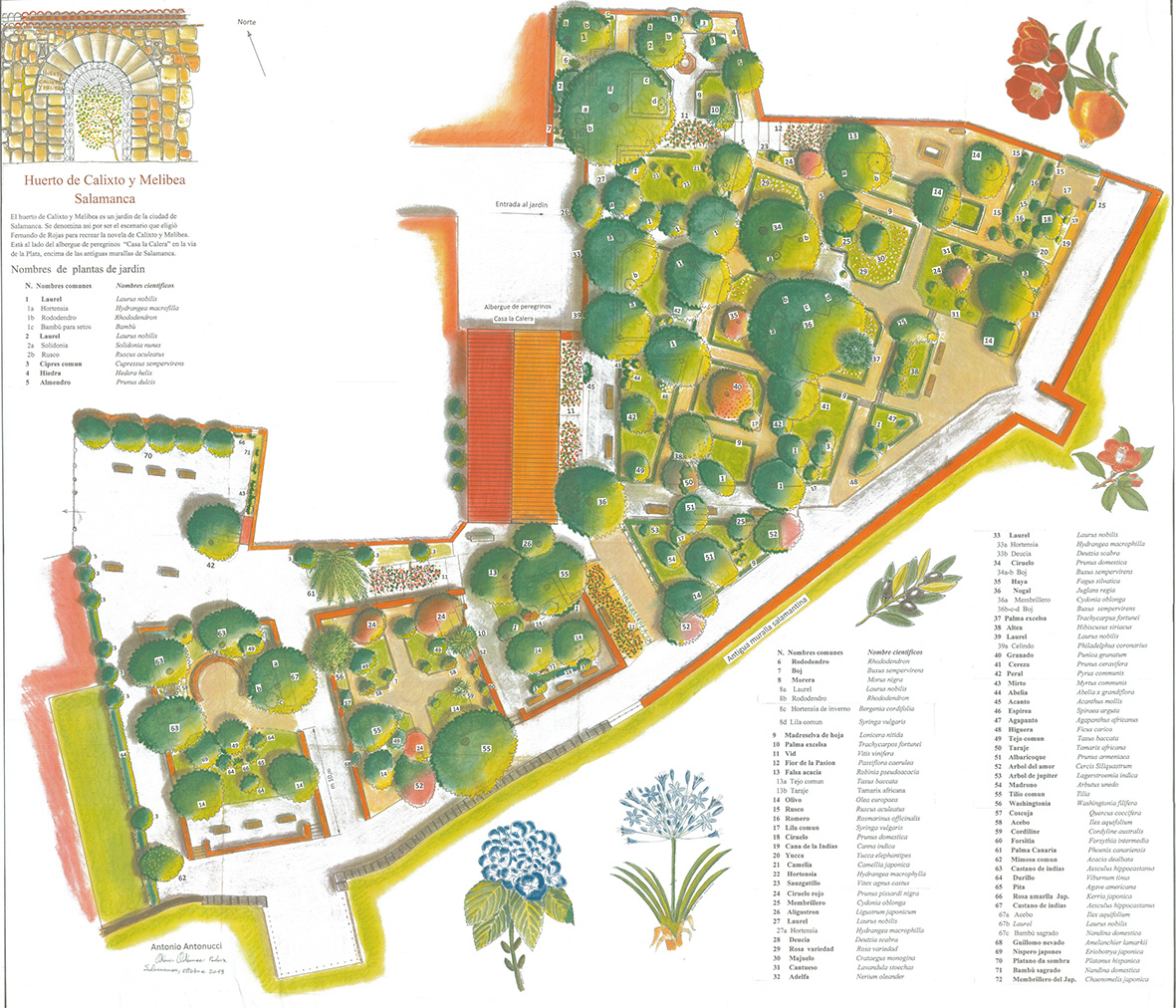
A stone wall, in which a semicircular arch with large voussoirs opens, gives access to a lush garden. The rich vegetation, the trees that barely let light through, and the legend hypnotize those who cross this door. The main path leads to the well, around which the irregular and terraced garden structure is articulated. The space is divided into 16 flowerbeds delimited by boxwood hedges, with their interior spaces occupied by fruit trees interspersed with a varied vegetation of plants and shrubs. Walking through the Garden of Calixto and Melibea today is to explore a space that preserves the memory of its past as an orchard, transformed today into an urban garden full of life and botanical diversity. Its paths wind among fruit trees, medicinal plants, ornamental species, and others associated with ancient beliefs and magical uses.
THE FOUNTAIN AND THE MULBERRY TREE
At the entrance, next to an old wall covered with climbing plants, a magnificent black mulberry tree immediately catches the eye, shading the sculpture of the procuress, probably a descendant of those mulberry plantations promoted in Salamanca between the 18th and 19th centuries for silkworm breeding. Next to the mulberry tree, a fountain and stone benches create a romantic corner cradled by the murmur of water.
THE WELL
In the heart of the garden stands a well with a granite wellhead, a silent witness to countless love stories, represented by the many padlocks hanging from its arch, which connects it directly to Rojas's work.
THE WALL VIEWPOINT
The southern part of the garden stands on the wall, with two viewpoints located on two towers of the medieval enclosure. Walking along its wide rampart walk is a delight for the senses and the best viewpoint over the Cathedral and the immense complex of the Convent of San Esteban.
THE VIZIER'S GARDEN
Thanks to the less dense vegetation, this spot offers an unobstructed view of the New Cathedral's dome and the Bell Tower. The selfie spot has been installed right here, a perfect place to capture a self-portrait with this exceptional backdrop.
From the Vizier's Garden viewpoint, located on a wall tower, the striking stained-glass windows of Casa Lis can also be appreciated.
A wide variety of plants can be found in this garden. You can find: laurel, ivy, almond trees, acanthus, vines, mulberry, passion flower, olive trees, rosemary, plum trees, hydrangeas, oleander, walnut tree, beech, cherry tree, myrtle, fig tree, yew, apricot tree, linden, holly, agave, horse chestnut, loquat, plane tree, bamboo, and Japanese quince.