
SCALA COELI VIEWPOINT
30 minutes
Free visit price
- Individual - 3.75 €
- Grupos - 3.25 €
- Niños (Edad máxima: 12) - 0.00 €
After the expulsion of the Jesuits in 1767, the building was divided into three parts. The church and the sacristy were handed over to the Royal Clerecía de San Marcos, giving rise to its current name. The southern wing, organized around the community cloister, was designated for Irish students. Currently, that cloister houses the Vargas Zúñiga library. The college, structured around the main cloister, became the seat of the Conciliar Seminary. During the 19th century, and especially during the Peninsular War, the building was used on numerous occasions as barracks and a field hospital by the troops stationed in the city. Subsequently, it resumed its function as a seminary and, since 1940, became the main headquarters of the Pontifical University of Salamanca.
Although the church was consecrated in 1665, the last section of the facade remained unfinished. The date 1754, engraved on the reverse of the pedestal of the Virgin that crowns the belfry, indicates the year this work was completed. Architect Quiñones placed here the towers he had designed for the City Hall facade in Plaza Mayor, which he never got to build. The beautiful wooden model is preserved, showing similarities, but also differences, with those of the Clerecía, as Quiñones designed new towers for the Church of the Holy Spirit (Clerecía), with two superimposed octagonal bodies. In the corners of the second body, he placed obelisks preceded by statues representing the Doctors of the Church, saints of the company, and Theological and Cardinal Virtues.
Since 2012, it has been possible to climb the towers of the Clerecía Church. The route is called Scala Coeli (“Stairway to Heaven”). The ascent is made through the interior of the north tower. Through the original wooden staircase, one reaches the tribune located above the chapels on the epistle side. From an open balcony, the church's Main Altarpiece can be seen. Continuing the tour, the staircase ascends, zigzagging close to the walls of the stairwell until reaching the towers. The walk through the towers is a unique experience that allows us to discover spectacular panoramic views of the city.
VIEWS OF THE SCALA COELI VIEWPOINT Crowning the ascent of the Clerecía Towers is a visual experience difficult to describe. The spectator is truly impressed by the splendor of the Baroque architecture and decoration that surrounds us. The first thing that attracts our attention is the building itself. The foreground is overwhelming. From the north tower, we have a new perception of the Royal College of the Society of Jesus. Beneath our feet is the impressive Cloister of Studies, a masterful work of Spanish Baroque. Above the cloister rises the north Pavilion, an immense porticoed gallery over a hundred meters long, which closes the building on its northern flank.
Turning our gaze, we see the church's large dome rising above the transept. A thick lead sheet gives it that peculiar grayish color. From here, the inclination of the lantern is barely perceptible, so evident from other perspectives.
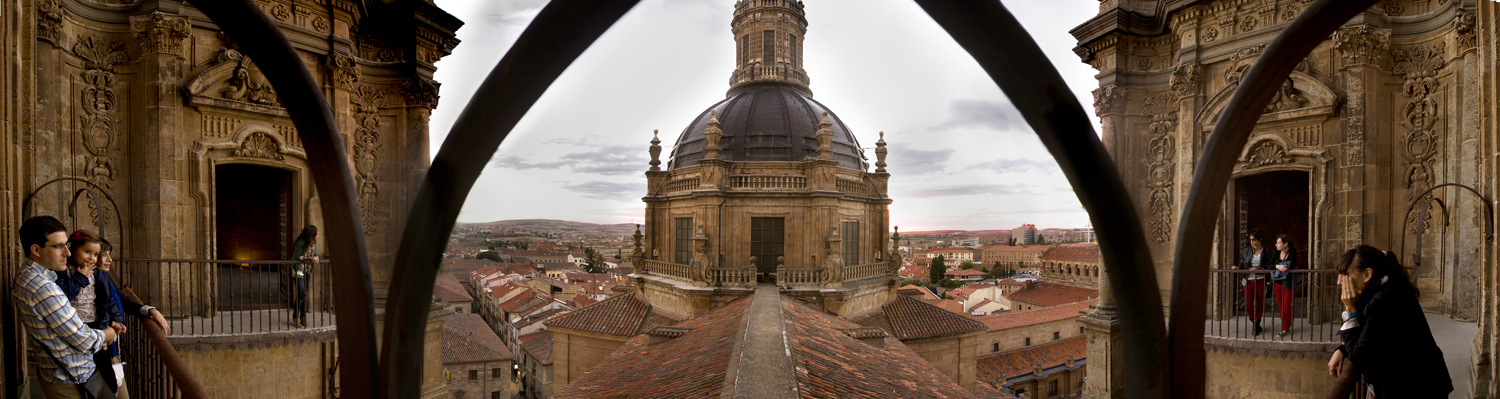
From one of the balconies, we see its twin sister, the south tower. Given the proximity, we can appreciate all the details of its beautiful decoration. We cannot help but wonder why so much work and dedication was invested in a space only accessible to bell ringers. If you look closely at the pedestal supporting the image of the Virgin, you will see the inscription “1754”, which informs us of the date when the church was completed. 137 years had passed since the work began. A walkway located at the base of the belfry allows access to the south tower. From this balcony, we once again have the dome in front of us, home to several families of storks who have their nests here with their young, who do not seem to be bothered by the presence of visitors.
From the Clerecía Towers, we have a 360º view. Four balconies in each of the towers allow us to scan the city in the direction of the four cardinal points: To the south: we see, first, the Anaya College and the octagonal dome of the Church of San Sebastián. Between the college and the cathedral, the large cedars of Plaza de Anaya stand out. The New Cathedral dominates the panorama, highlighting its large dome and the Bell Tower, the tallest in the city. Every October 31st, the Mariquelo climbs to the top of the bell tower in thanksgiving because no one died in Salamanca in the Lisbon Earthquake of 1755. The Mirador de Ieronimus, located in the towers of the Salamanca Cathedral, is another key point from which to contemplate the city from above. Continuing our visual journey, we see the sequoia in the cloister of the University's Historic Building (Escuelas Mayores) located in front of the university chapel's belfry. Our journey ends at the great dome of the Church of La Clerecía.
To the north: The gaze slides towards the Cloister of Studies, which extends at our feet with its dynamic architecture. Behind the imposing north pavilion of the Pontifical University, which stretches for over a hundred meters, a succession of monuments of great patrimonial richness unfolds. From left to right, the façade and dome of the Archbishop Fonseca College, the elegant Baroque dome of the Church of La Purísima, the sober Gothic apse of the Convent of Las Úrsulas, and the Church of San Benito stand out. Towards the northeast, the monumental façade of Salamanca City Hall and the bell tower of the Church of San Martín de Tours stand out, completing an urban landscape of great historical richness.
To the East: beneath our feet, a singular image of the patio of the Casa de las Conchas unfolds, seen from above. Beyond, a green patch of trees indicates the location of Plaza de Colón, a landmark in the urban landscape. Around it, the robust Torre del Clavero, the Church of San Pablo, and the two almost twin towers of the Palacio de Orellana and the Torre de los Anaya stand out.
To the southeast: Palominos Street visually guides us to the majestic Convent of San Esteban. From this panoramic view, the imposing church is fully appreciated, with its elegant dome, a work by Rodrigo Gil de Hontañón, and the splendid façade sculpted by Juan de Álava. In the scene, one of the towers of the Colegio de Calatrava emerges from behind, while, in the foreground, the Convent of Las Dueñas reveals the delicate gallery of its upper cloister, adding a touch of mystery and beauty to the architectural ensemble.