
CUEVA DE SALAMANCA
30 minutesNext to it stands a section of the wall that protected the city in the Middle Ages and the Tower of the Marquis of Villena. This tower is closely linked to the famous legend that has given the site its renown: the tale of the teachings of occult arts that, according to tradition, were imparted in the cave and have fueled the imagination of travelers and writers since ancient times.
Today, this space combines heritage, landscape, and myth, becoming an essential stop for those who wish to discover Salamanca's most enigmatic and evocative side.
Free visit price
- Individual - 0.00 €
The remains of the Church of San Cebrián (or San Ciprián) are located on Cuesta de Carvajal, on the slope that descends from the Teso de las Catedrales towards the Arroyo de Santo Domingo. This temple was situated within the layout of the first medieval wall, forming part of its structure. Its apse stood out as a defensive cube protecting the city's entrance through the Postigo de San Ciprián.
The Church was founded by Frankish settlers in the mid-12th century, in the Azogue Viejo area. It is located behind the cathedral, in what eventually became the canons' quarter. It cannot be ruled out that its dedication to San Cipriano indicates the existence of ancient magical rites at the site, prior to Christianity. San Cipriano of Antioch, a magician and necromancer before converting to Christianity, would eventually be venerated as a protector against all kinds of evil spells.
Isabel the Catholic ordered its walls to be bricked up when she learned that hidden rites were practiced there. The parish was suppressed in the 16th century, and its stone was used for the construction of the New Cathedral. In its memory, a cross with the statue of San Cebrián was placed in the square, accompanied by an inscription that read: "This was the church of San Cebrián." Currently, this cross is in the cemetery of San Carlos Borromeo. Recently, in 2025, the sculptor Oscar Alvariño created a reproduction of the cross, which has been placed in its original location. After the destruction of the church, the crypt served as a storage room for a nearby palace; it was later used as a bakery warehouse and even a coal store.
In the early 1990s, this space was excavated and restored, opening to the public in 1993. Since then, it has consolidated as an archaeological site of great interest, housing the emblematic Villena Tower, a section of the historic Old Wall, and the enigmatic Salamanca Cave. Across the street is the Interpretation Center of the Walls of Salamanca, Salmantica Sedes Antiqua Castrorum, where significant remains of the Iron Age wall and the medieval enclosure can be seen in situ.
THE SALAMANCA CAVE IN LITERATURE The legendary Salamanca Cave has left a deep mark on literature, becoming a source of inspiration for great writers. Cervantes dedicated an interlude to it, Ruiz de Alarcón wrote a comedy about it, and Quevedo mentioned it in his texts, echoing the mysterious adventure of the Marquis of Villena. In 1733, the Portuguese Botello de Moraes imagined a fantastic story in The Caves of Salamanca, and even Walter Scott included it in his poetry, evoking a magician whose power could make the bells of Nôtre Dame ring when he waved his magic wand. The cave will once again play a leading role in Luís García Jambrina's The Stone Manuscript.
The cave's story crossed borders. In some parts of Hispanic America, caves inhabited by witches and demonic beings are called Salamancas. And Unamuno records this when he says: "Of the old necromantic and alchemical legend of this city, of what has made the name of Salamanca mean what it means in remote corners of that American land –the Salamanca!–, of that, what should I tell you? They still discuss here where the famous caves were located in which the Marquis of Villena practiced his sorcery and enchantments.”
Throughout the tour, several signs inform visitors about the history and legends associated with this place.
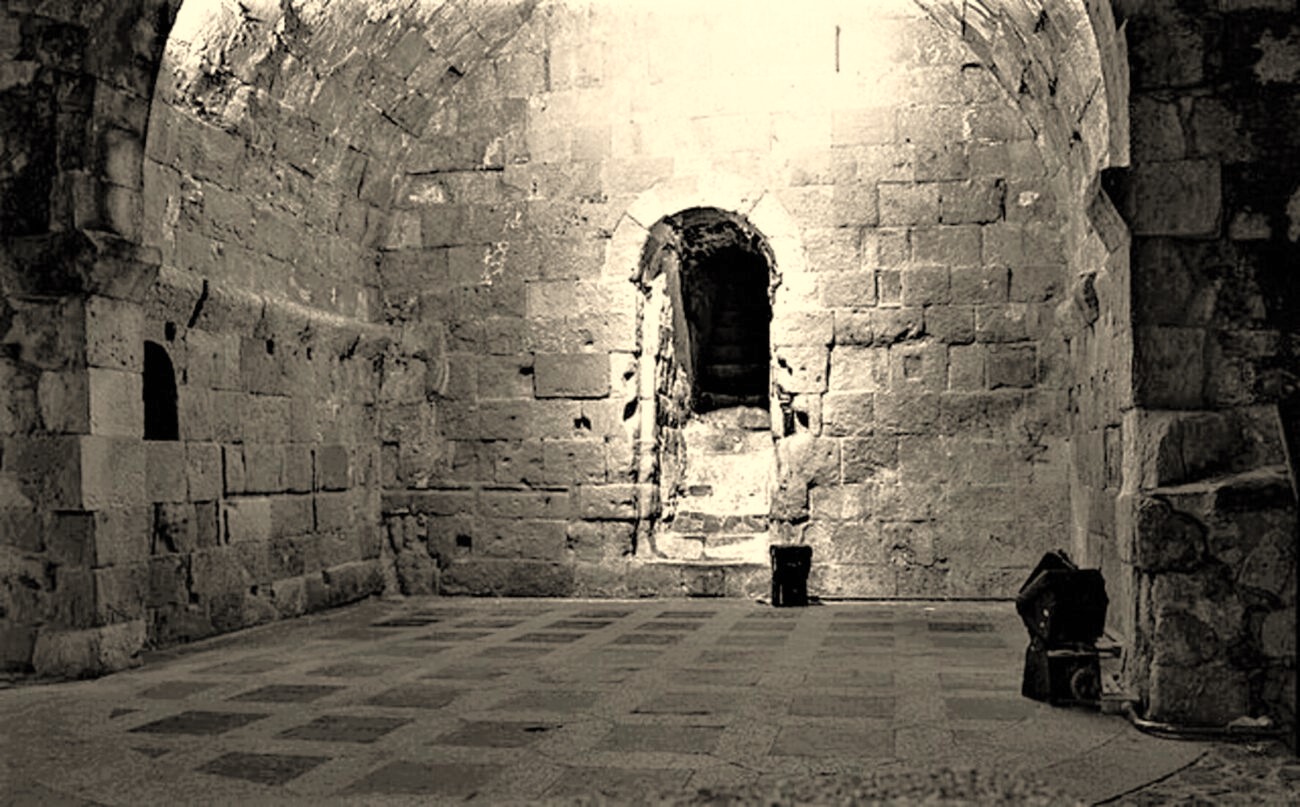
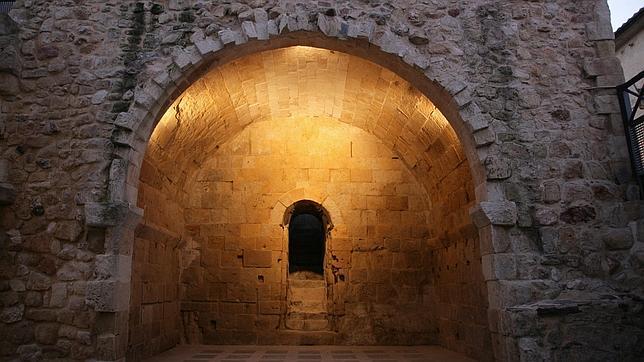
1.-CHURCH AND CRYPT(Salamanca Cave) What has reached us today is limited to the church's crypt. On the upper level, excavations and restorations in the 1990s brought to light the church's perimeter walls. It was a temple of reduced dimensions, with a rectangular plan and a semicircular apse. A grate currently covers the access to the crypt from the church.
The street's steep slope was used to build a crypt beneath the main chapel. Communication between the crypt and the apse was through a narrow staircase with a slate barrel vault. This space is covered with a barrel vault that starts from a chamfered impost line. On the pavement, the location of the semicircular apse and its thickness can be seen. The apse also served as a defensive bastion of the wall and protected the immediate gate of San Cebrián.
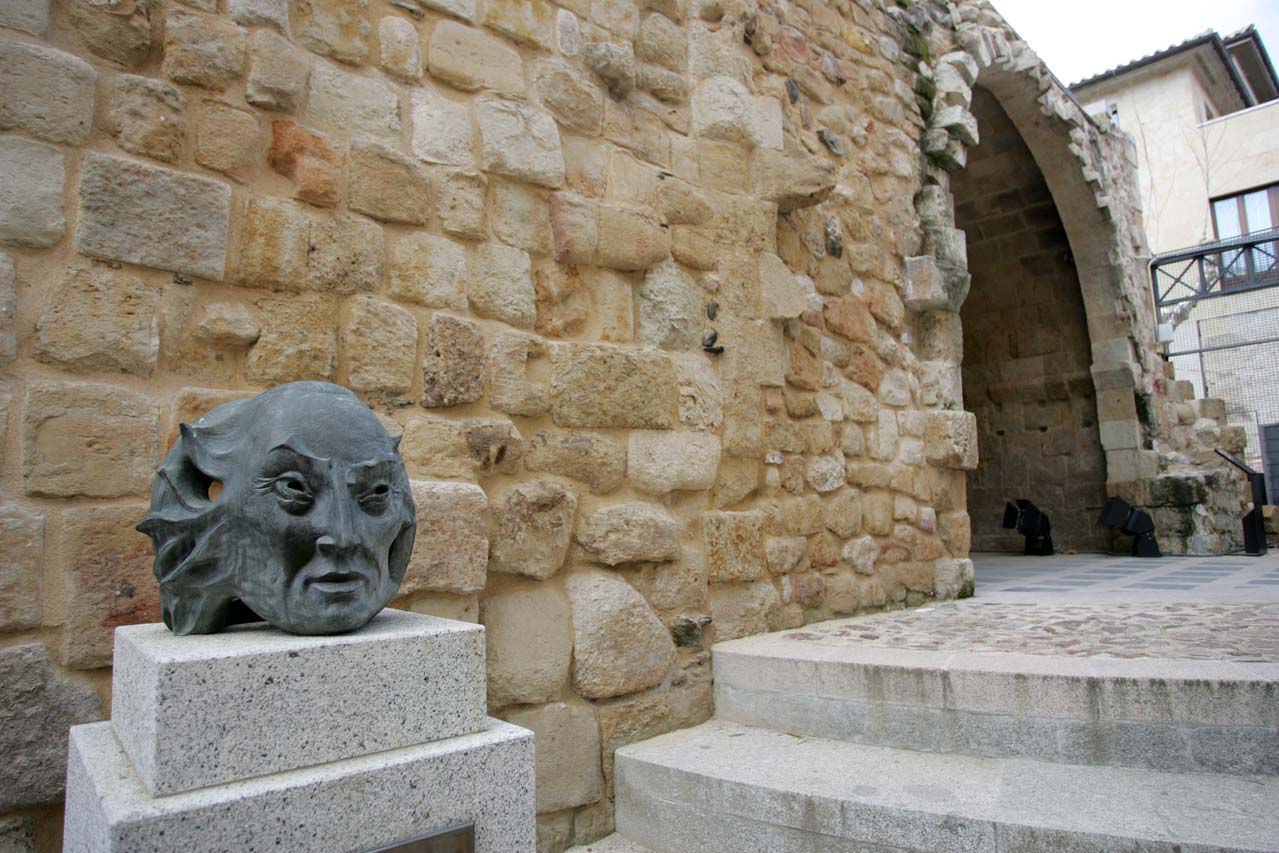
Here is an enigmatic bust of Diego de Torres Villarroel, a work by sculptor Agustín Casillas. Diego de Torres was a multifaceted figure; throughout his life, he was a writer, astrologer, mathematician, priest, exorcist, doctor, bullfighter. The effigy is full of mystery; he is depicted frontally, with demonic eyes and with the image of an owl on the reverse.
2.- WALL In this space, the section of the Old Wall that extends between the apse of the San Cebrián church and the so-called Marqués de Villena Tower is preserved. This section of the medieval wall, built in the 12th century, was part of the defensive system that protected the Teso de las Catedrales (Cathedrals' Hill).
This section was partly destroyed in 1979 during the demolition of a palace known as Casa de la Concordia (House of Concord). Subsequent excavations brought to light tombs from the San Cebrián cemetery and, in the lower levels, strata of pre-Roman occupation. The cut made in the wall allows the thickness and construction technique to be seen. The tower and wall rest on geological strata, and in their elevation, different phases of their construction and reconstruction can be recognized.
3.- MARQUÉS DE VILLENA TOWER From here, we can access the Marqués de Villena Tower, a central character in the legend of the Cave. It is a 15th-century construction that rests on one of the bastions of the city's primitive wall. It is the only structure remaining of the Palacio Mayorazgo de los Albandea (Albandea's Majorat Palace), a palace that was accessed from San Pablo Street. At the access door and on the corners at the top of the tower, it features coats of arms of the Sánchez de Palenzuela family, to which it appears to have belonged. Inside, metal stairs allow ascent to the viewpoint from which there are unbeatable views of the city's southeastern area.
MUSEUMIZED SPACE On the wall, in the space between the church and the Tower of the Marquis of Villena, a modern concrete building was constructed where archaeological remains recovered from excavations carried out in the nineties in the church and in the necropolis of San Cebrián church are exhibited. In it, you can see: • wooden corbels with polychrome faces • Romanesque moldings, with checkerboard and palmette decoration • medieval tombs and discoidal stelae from the necropolis of San Cebrián church.
Across the street is the Wall Interpretation Center, Salmantica Sedes Antiqua Castrorum, where important remains of the Castro wall and the medieval enclosure can be seen in situ.